This post, the second in a series on how to improve your own spinal health, will focus on common daily activities. Likely, you don’t spend much time thinking about how you stand, sit, carry objects, talk on the phone, and other such things because it has become so second-nature to you over the years. I’d like to draw your attention to a few of these seemingly harmless activities, suggest some easy ways to tweak your habits and, ultimately, help prevent future damage to your spine.
Essentially, your muscles are constantly either getting
stronger or weaker, and chairs that don’t require you to do any work or use any
strength are bad news. If you sit for 9 hours straight every day in one of
these chairs (probably in an office work environment), what do you think the
end result will be? We put approximately 30% more pressure on our low backs when sitting as opposed
to standing, so, if you can, try to create a standing workstation for yourself,
as I have in my own office. If you do this, make sure your keyboard is at elbow
level and the bottom 1/3 of your monitor is at eye level. This will require you
to look slightly up at the screen, which encourages a proper neck curve.
 For many of you that may not be possible, but that doesn’t
mean there aren’t alternatives. If your boss allows it, you may sit on a large
exercise ball. If you’re sitting up straight, as you should be, an exercise
ball will engage your core and strengthen it. And if an exercise ball isn’t
professional enough for your work environment, I also sell an excellent cushion
that turns any chair into a simulated exercise ball and will still engage your
core muscles (see picture below). Ask me if you’re interested in purchasing one.
For many of you that may not be possible, but that doesn’t
mean there aren’t alternatives. If your boss allows it, you may sit on a large
exercise ball. If you’re sitting up straight, as you should be, an exercise
ball will engage your core and strengthen it. And if an exercise ball isn’t
professional enough for your work environment, I also sell an excellent cushion
that turns any chair into a simulated exercise ball and will still engage your
core muscles (see picture below). Ask me if you’re interested in purchasing one. 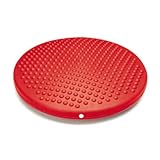 If you find that you’re stuck on a normal office chair, you
should definitely get up and stretch every so often. I recommend moving for
approximately 10 minutes every hour, if possible. Remember what I said earlier
about where your computer monitor should be! And pay attention to your posture
as you sit at your computer; if you find that you’re hunching over, force
yourself to straighten up until good posture becomes a habit.
If you find that you’re stuck on a normal office chair, you
should definitely get up and stretch every so often. I recommend moving for
approximately 10 minutes every hour, if possible. Remember what I said earlier
about where your computer monitor should be! And pay attention to your posture
as you sit at your computer; if you find that you’re hunching over, force
yourself to straighten up until good posture becomes a habit. 
Even when work is over, most people spend lots of their free
time sitting, so pay attention to the couches and chairs you use. It is
important to have adequate lumbar support in these pieces of furniture the same
way it’s important in a mattress, as I mentioned in the first post of this
series. We can end up sitting for hours on end, and keeping your body in the
same position with little to no support for the lower back is asking for
trouble. If buying new, spine-friendly furniture isn’t in your budget, though,
the next best thing is to put a pillow or two behind your lower back. Also, if
you’re sitting in a recliner or in a reclined position, bend your knees and
hips at 90°. You can put a pillow or other object to support them if that’s
more comfortable for you.

Another thing to keep in mind is the fact that you put more
weight on your discs when leaning, twisting, or rotating when sitting. I have
seen patients who actually threw out their backs by picking up a pencil after a
long day of sitting at a desk. Remember to turn your entire body when you need to reach for something, and above all, do
not combine leaning, twisting, and rotating your body all at once. When you
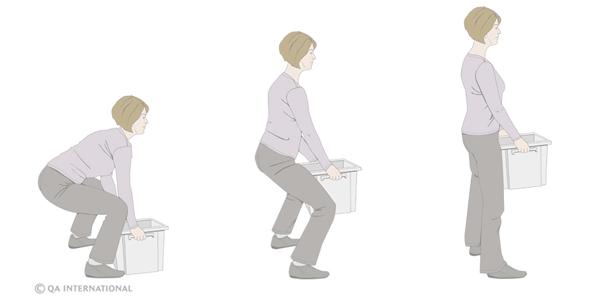
need to pick something up for any reason, in the workplace or not, try to do
what infants do: squat, pick the item up, use your legs to stand up straight
again, and then squat to set the item back down. Use this simple rhyme to
remember: toes and nose. When you
lift an item, you should point both your toes
and your nose towards it. Using the
strength of your back to pick things up—especially heavy things—is never a good
idea.
Now, a note specifically for men (and women who carry their
wallets in their back pockets). If you want to demonstrate what sitting on your
wallet does to your back, try sitting half of your buttocks on the palm of your
hand and see how it causes an imbalance to your spine. This simple, seemingly
unimportant habit can eventually lead to spinal problems, so the next time
you’re about to sit down with no regard for the wallet in your back pocket, simply remove it
and put it back when you stand up again. Easy, right?
 And a note specifically for women (and men who carry
over-the-shoulder bags or backpacks). Human hands are designed to carry things. Our shoulders aren’t. And yet, women
constantly use their shoulders to bear the weight of heavy purses. The average
American woman’s purse weighs a whopping 25 pounds! Regardless of whether you
carry a purse on one side for your entire life, or switch sides every so often,
just imagine the strain you’ll be putting on your body after years of this. Try
lightening your purse by taking out anything non-essential, carry a handbag
rather than a purse with a shoulder strap, and if you carry a backpack, use both straps to distribute the weight
more evenly between your shoulders.
And a note specifically for women (and men who carry
over-the-shoulder bags or backpacks). Human hands are designed to carry things. Our shoulders aren’t. And yet, women
constantly use their shoulders to bear the weight of heavy purses. The average
American woman’s purse weighs a whopping 25 pounds! Regardless of whether you
carry a purse on one side for your entire life, or switch sides every so often,
just imagine the strain you’ll be putting on your body after years of this. Try
lightening your purse by taking out anything non-essential, carry a handbag
rather than a purse with a shoulder strap, and if you carry a backpack, use both straps to distribute the weight
more evenly between your shoulders.  The last, but certainly not least, important tip is to pay
attention to how long you’re on the phone every day. If it’s any longer than 1
hour, you should seriously consider purchasing a headset with an earpiece
instead. An even simpler option is to use your speakerphone instead of holding
the phone directly to your ear for an extended period of time. And, contrary to
popular opinion, switching which ear you use doesn’t lessen the damage to your
neck—it only damages all the parts of your neck equally, and that’s hardly a
positive choice to make!
The last, but certainly not least, important tip is to pay
attention to how long you’re on the phone every day. If it’s any longer than 1
hour, you should seriously consider purchasing a headset with an earpiece
instead. An even simpler option is to use your speakerphone instead of holding
the phone directly to your ear for an extended period of time. And, contrary to
popular opinion, switching which ear you use doesn’t lessen the damage to your
neck—it only damages all the parts of your neck equally, and that’s hardly a
positive choice to make!
As you can see, there are many variations to all the tips
I’ve provided, and you may even come up with some of your own! The key is to
never see these everyday activities as insignificant. Everything you do, from
the moment you wake up to the moment you go to sleep at night (and when you’re
sleeping, too!), may eventually add up to make the difference between a healthy
or an unhealthy spine. Keep this in mind, and stay tuned for my next blog post,
which will cover two very important
topics: exercise and nutrition.